
The Rhenish League of Cities and the Birth of Urban Influence in Medieval Europe in the 13th century
Imagine a time when the empire was rudderless, the throne of the Holy Roman Empire empty, and the scramble for power rippled across every corner of the land. Princes, bishops, and nobles seized the moment to expand their influence, but in this chaos, an unexpected force began to rise—cities. And at the heart of this urban revolution was the year 1254, when towns along the Rhine defied the odds to form an unprecedented alliance. Welcome to the story of the Rhenish League of Cities.
Prince-Electors of the HRE

The imperial prince-electors Left to right: Archbishop of Cologne, Archbishop of Mainz, Archbishop of Trier, Count Palatine, Duke of Saxony, Margrave of Brandenburg and King of Bohemia (Codex Balduini Trevirorum, c. 1340)
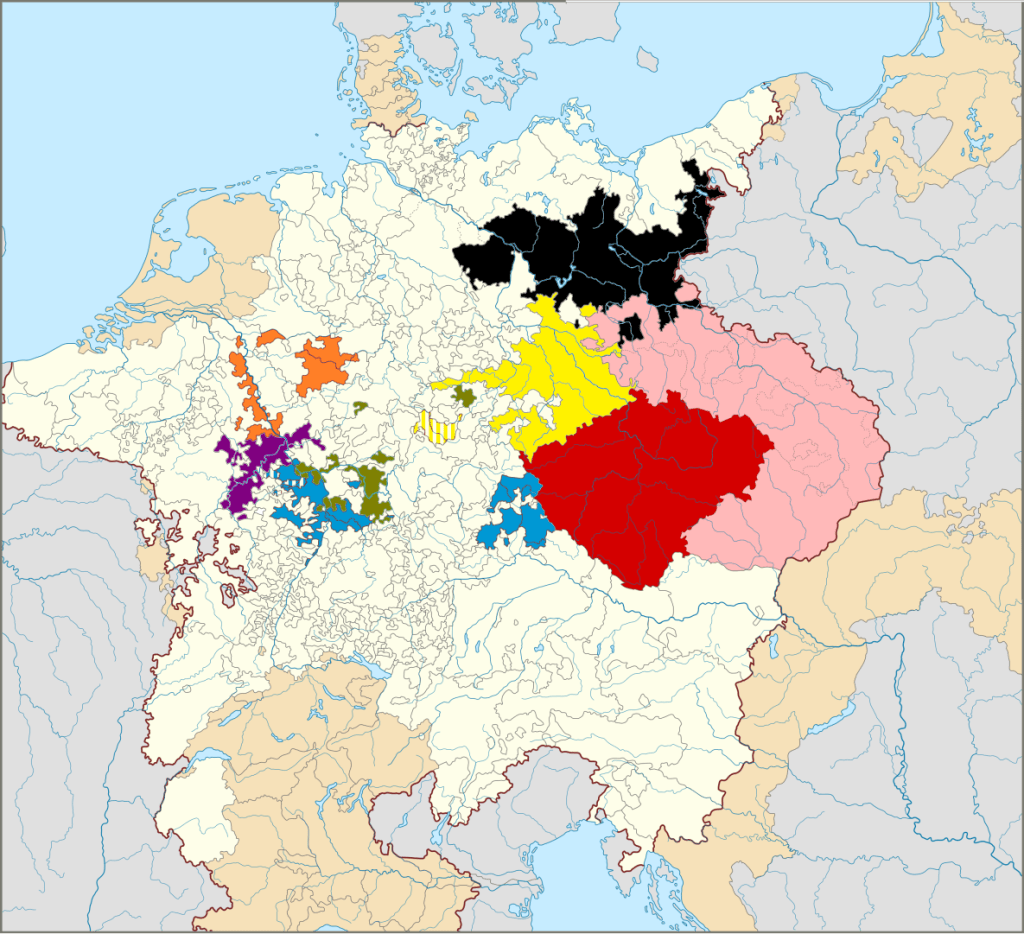
Orange: Archbishopric Cologne, Purple: Archbishopric Trier, Green: Archbishopric Mainz, Blue: Count Palatine of the Rhine, Red: King of Bohemia, Black: Margrave of Brandenburg, Yellow: Duke of Saxony
The Interregnum – the time without an Emperor

Don’t miss any new episode!
 The History of Cologne Podcast
.png)