
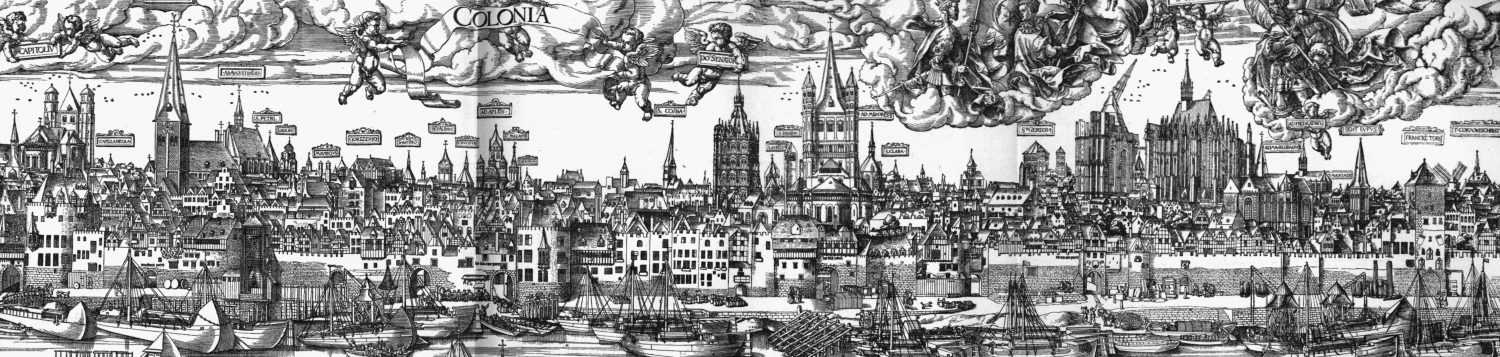

1271: Three years after civil war tore Cologne apart, the aging Dominican friar Albertus Magnus was sent to end the deadlock between a captive archbishop and an ambitious count. But peace always comes at a cost — and in Cologne, that cost would change the balance of power for a century.
Albertus Magnus

In 1271 Albertus Magnus is now in his 70s. Can he make a peace deal between the city of Cologne and the Archbishop? As a member of the still young Dominican order, he even made it to bishop of Regensburg. An office he stepped down from after a short time because he was a scholar through and through. As the teacher of Thomas Aquinas, he is one of the most intellectual personalities of the Middle Ages.
Engelbert von Falkenburg

In 1271, Engelbert von Falkenburg served as Archbishop of Cologne during a time of political uncertainty in the Holy Roman Empire. Despite being successful as an imperial prince, he was not really doing well in managing his defacto capital of Cologne. After many years of wars and fighting, in 1271, Engelbert is a prisoner of the count of Jülich, an ally of the rich citizens of Cologne for now three years.
Monument of the Battle of the Ulrepforte from ca. 1360

Nearly a century after the bloody night of 1268, Cologne’s ruling families ensured the memory of their victory would not fade. Around 1360, they commissioned a stone relief on the city wall near the Ulrepforte — today recognized as Germany’s oldest monument commemorating a historical event.
The relief once stood where the battle had raged and was vividly painted like medieval sculpture. In its upper half, Christ sits enthroned among stars, flanked by angels holding Cologne’s coats of arms, while saints hover above — a vision of the “holy city.”
Below, however, unfolds a very earthly struggle: mounted warriors of the victorious Overstolzen charge their enemies. The archangels Michael and Gabriel lend divine support as the fallen — among them Dietrich von Falkenburg, the archbishop’s brother — are dragged toward hell by a clawed devil who also tears down the archbishop’s banner.
Originally placed in the city wall, the relief now rests in the Cologne City Museum for conservation. A faithful copy still marks the spot at Sachsenring, a quiet reminder of a night when faith, pride, and politics collided in medieval Cologne.
Link to the painted version: Link
Tomb of Albertus Magnus in St. Andreas

 The History of Cologne Podcast