
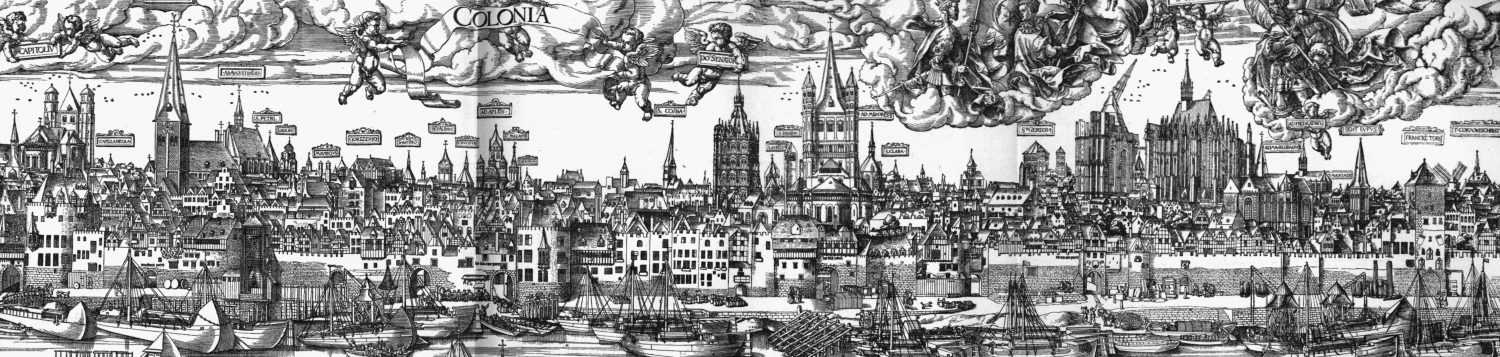
In 1275, Cologne entered an unexpected agreement that reshaped its relationship with one of the most powerful men in the empire: the new Archbishop of Cologne. At the same time, the city received a remarkable new Gothic seal—an object that tells us more about medieval identity, politics, and ambition than any charter ever could.
How did all this come together? And why did it matter so much?
Join us as we follow the early moves in a story that will echo all the way to Worringen.
Siegfried von Westerburg
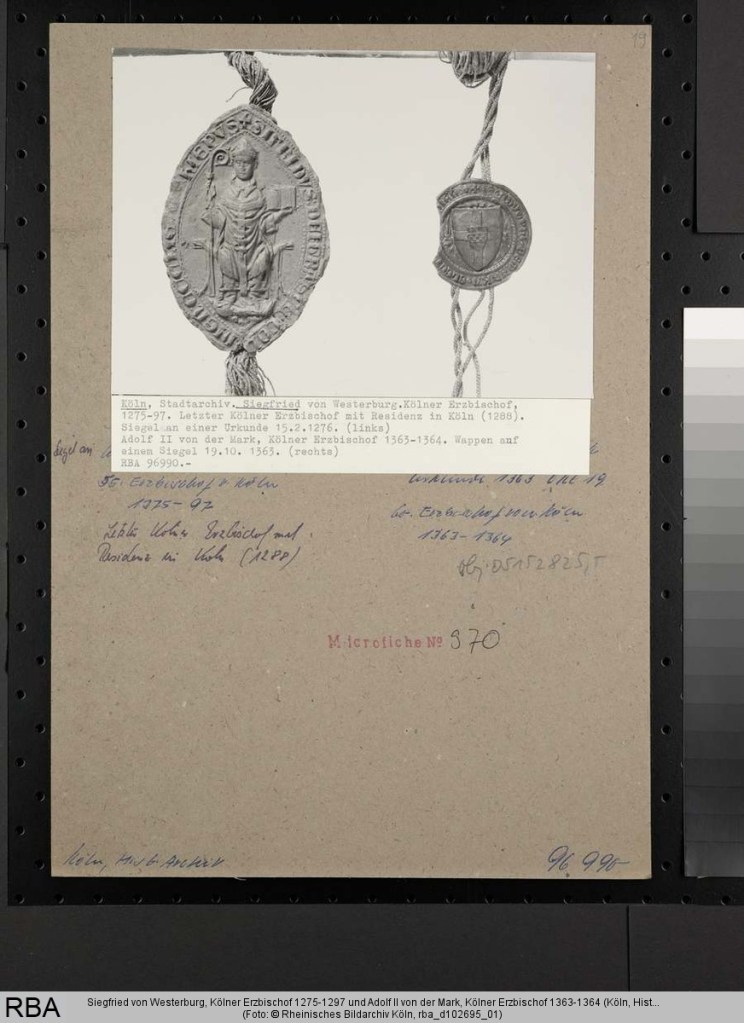
Bildnachweis: Rheinisches Bildarchiv Köln, 2024
Siegfried von Westerburg, Kölner Erzbischof 1275-1297 und Adolf II von der Mark, Kölner Erzbischof 1363-1364, 1276 & 1363, Historisches Archiv der Stadt Köln, Köln.
The Seal of Archbishop Siegfried von Westerburg
Siegfried von Westerburg (born around 1235) came from a noble family rooted around Runkel Castle on the river Lahn. Before becoming Archbishop of Cologne, he had already built an impressive career within the Church’s power structures: he served as Provost of Mainz Cathedral and held several lucrative ecclesiastical offices across the empire. Like many high nobles of his time, Siegfried was not a theologian but a politically experienced, militarily skilled leader who had personally taken part in armed conflicts—he was even captured alongside the previous Archbishop Engelbert von Falkenburg in 1267.
Although he received only one vote in the Cologne Cathedral Chapter’s election of 1275, Siegfried refused to accept defeat. Instead, he travelled to Lyon to appeal directly to Pope Gregory X, who annulled the election and personally appointed Siegfried as the new Archbishop of Cologne. His consecration by the Pope himself gave him exceptional legitimacy.
Upon taking office, Siegfried inherited a deeply fractured archbishopric: Cologne was still under interdict, the city’s patricians distrusted the archbishops after decades of conflict, and many regional nobles—Berg, Jülich, Brabant, Hesse—were openly hostile to Cologne’s territorial power.
Unlike his predecessor, Siegfried initially acted with strategic restraint. He lifted the interdict, made peace with the city, and concluded a landmark friendship treaty with Cologne in June 1275. He also allowed the city to adopt a new Gothic seal—an object symbolizing Cologne’s renewed self-confidence and legal autonomy.
Politically cautious yet ambitious, Siegfried strengthened alliances with Mainz, Trier and Münster to counterbalance his regional enemies. But despite a promising beginning, tensions would later escalate dramatically, ultimately leading to the famous Battle of Worringen in 1288—one of the decisive conflicts of the Middle Ages in the Rhineland.
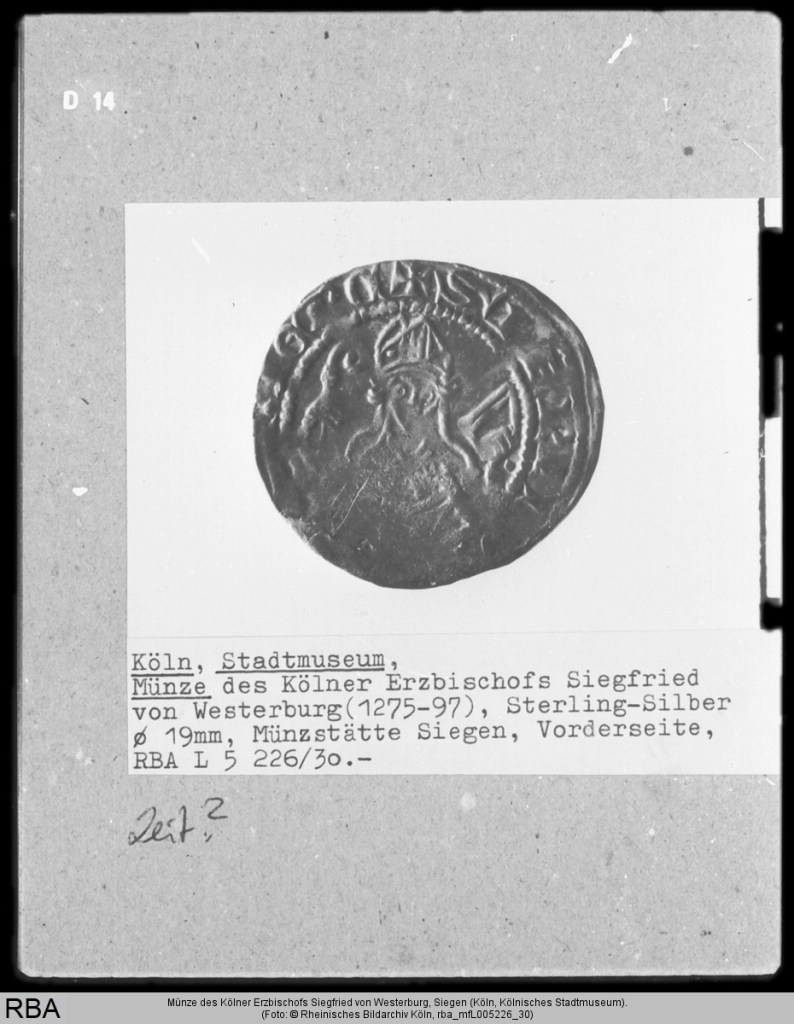
Bildnachweis: Rheinisches Bildarchiv Köln
Münze des Kölner Erzbischofs Siegfried von Westerburg, Siegen, 1275/1297, Kölnisches Stadtmuseum, Köln
A silver coin depicting Archbishop Siegfried von Westerburg
Worringen
Worringen was a settlement north of medieval Cologne, located along an important overland route toward the Lower Rhine, the Netherlands and the North Sea. Its position made it strategically significant for trade and military movement. The area belonged to the territory of the Church of Cologne, but neighbouring rulers—especially the Count of Jülich—sought to expand toward the Rhine and built castles there to secure influence. One of these fortifications was even constructed illegally, threatening Cologne’s trade routes and provoking both the city and the archbishop.

Because of these rivalries, Worringen became a hotspot of territorial tension in the late 13th century. The archbishop eventually built a counter-castle directly beside Jülich’s stronghold to challenge his power in the region. This cluster of contested fortifications turned Worringen into a symbolic and practical flashpoint long before it became known as the site of the famous battle of 1288.
In 1922, Worringen was incorporated as a city quarter of Cologne, still keeping its village-like surroundings.
The gothic City Seal of Cologne
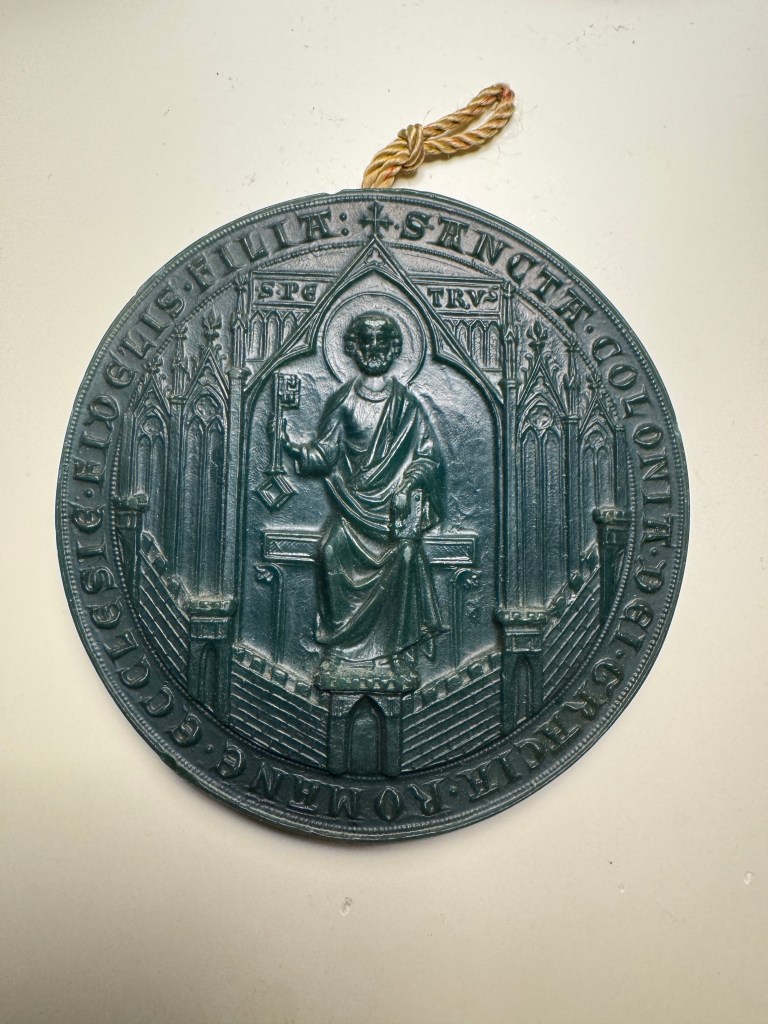
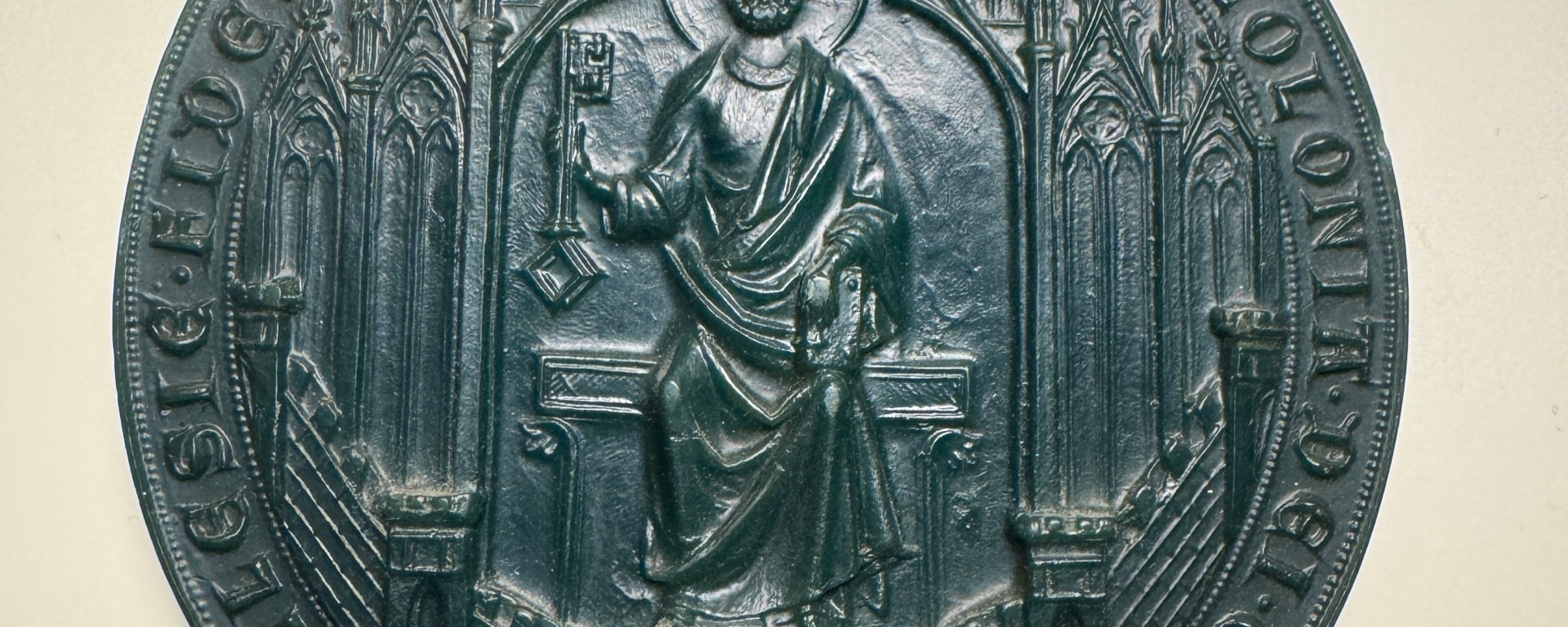
After Cologne’s original Romanesque city seal stamp disappeared in 1268, stolen by the influential family from Mühlengasse, the city found itself unable to authenticate documents and legally conduct affairs. A new seal became essential. In response, Cologne commissioned a beautifully crafted Gothic city seal, created by skilled local goldsmiths and designed to be difficult to forge in 1268.
The seal shows St. Peter enthroned beneath a Gothic canopy and framed by a symbolic city wall—possibly representing not only Cologne’s fortifications but also heavenly Jerusalem. Around the edge runs a proud Latin inscription: “Sancta Colonia Dei Gratia Romanae Ecclesiae Fidelis Filia” (“Holy Cologne, by the grace of God, faithful daughter of the Roman Church”), reflecting the city’s medieval self-image.
At 10.9 cm (4.3 inches) in diameter, it is one of the largest and most artistically admired medieval city seals in existence. The reverse, a smaller counterseal depicting St. Peter as a half-figure, served to prevent forgery. Both gothic seal stamps survive today and are in possession by the Cologne City Museum.
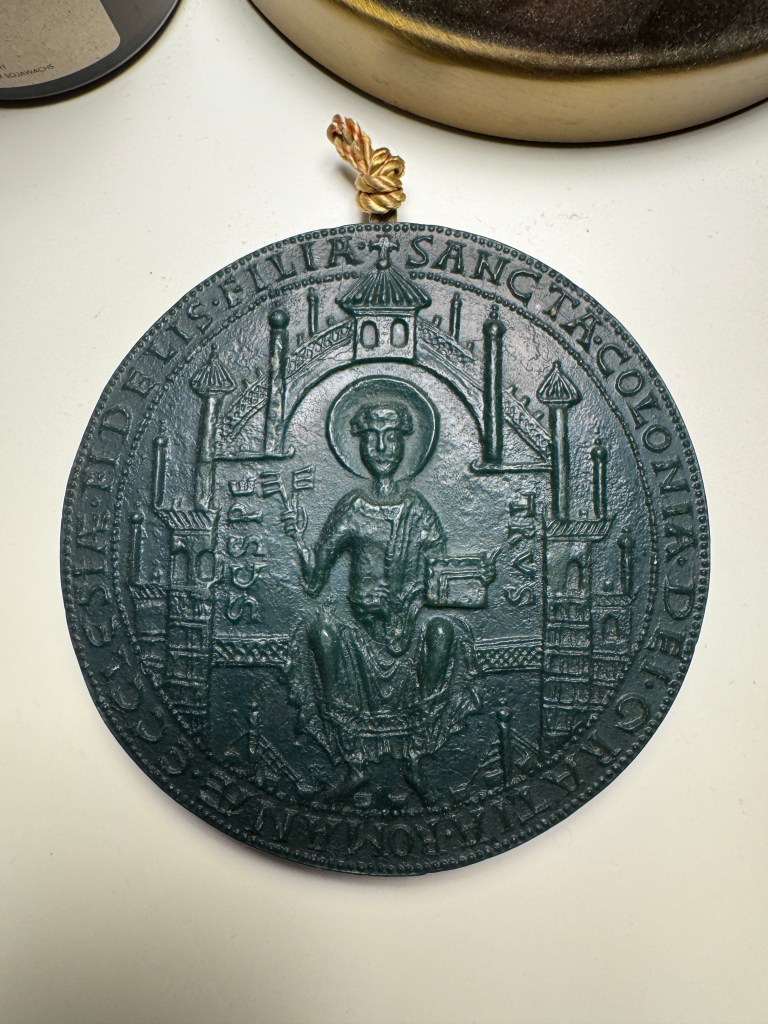
The old Romanesque City Seal from 1114 for comparison:
 The History of Cologne Podcast