#9 SPQR in CCAA – How the Romans Ruled Ancient Cologne

#9 SPQR in CCAA – How the Romans Ruled Ancient Cologne The History of Cologne

In this episode, we get a brief overview of how the Romans ruled ancient Cologne. Chronologically, the episode is not firmly docked to a date. In the context of our podcast so far, however, it describes political Cologne at the end of the 1st century AD, several decades after Vitellius and the Batavian Revolt. The Roman rule is consolidated and the Romans finally acknowledge in 85 AD that they will not conquer the Rhine side on the right bank of the Rhine. A good time to take a closer look at the political system of ancient Cologne and its surroundings. Especially the city senate, the high government offices of the city, and the governor will be examined more closely. This fits well because in the next episode we will talk about the great Roman Trajan, who becomes governor of Cologne here in 98 AD. There he will be surprised to learn that he has become the new emperor. In contrast to Vitellius, however, in a completely legal way. But Trajan is, as already mentioned, the subject of the next episode.

In this episode, we get a brief overview of how the Romans ruled ancient Cologne. Chronologically, the episode is not firmly docked to a date. In the context of our podcast so far, however, it describes political Cologne at the end of the 1st century AD, several decades after Vitellius and the Batavian Revolt. The Roman rule is consolidated and the Romans finally acknowledge in 85 AD that they will not conquer the Rhine side on the right bank of the Rhine. A good time to take a closer look at the political system of ancient Cologne and its surroundings. Especially the city senate, the high government offices of the city and the governor will be examined more closely.

This fits well because in the next episode we will talk about the great Roman Trajan, who becomes governor of Cologne here in 98 AD. There he will be surprised to learn that he has become the new emperor. In contrast to Vitellius, however, in a completely legal way. But Trajan is, as already mentioned, the subject of the next episode. (next episode: 8th June)

Listen to this episode:

spotify-podcast-badge-blk-grn-330x80
US_UK_Apple_Podcasts_Listen_Badge_RGB

Cologne and the province of Lower Germania (highlighted in red, next to “Germania Magna”) Click to enlarge the map!

Emperor Domitian creates the province of Lower Germania between 85-90 with Cologne as its capital. Source: Jastrow (2006), Gemeinfrei, https://commons.wikimedia.org/w/index.php?curid=1222636 Click to enlarge the picture!

The Praetorium

The Praetorium in its later final form in the 3rd century. Source: Nicolas von Kospoth (Triggerhappy) – Eigenes Werk, CC BY-SA 2.5, https://commons.wikimedia.org/w/index.php?curid=1071327 Click to enlarge the picture!
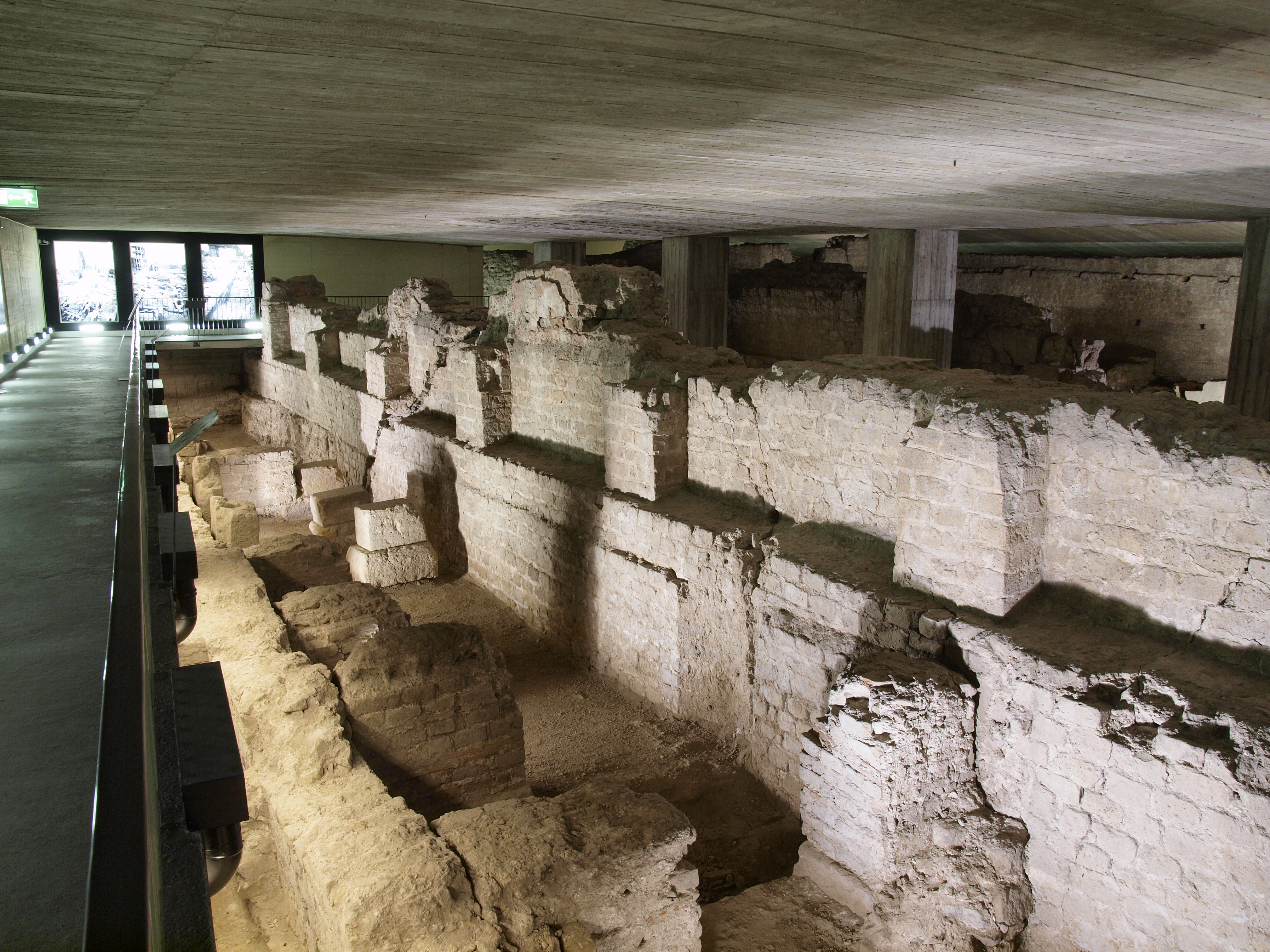
An excavated part of the Preatorium below the town hall of Cologne. As you can see in the back, when this picture was taken, the construction for the bigger museum has already started. The light in the back comes from the construction pit outside. We are still underground the modern street leve. Source by: Archäologische Zone Köln – Archäologische Zone Köln, CC BY-SA 3.0 de, https://commons.wikimedia.org/w/index.php?curid=22774300 Click to enlarge the picture!

#98 A Who’s Who of the Battle of Worringen 1288 The History of Cologne

On 5 June 1288, the Battle of Worringen took place, serving as the violent climax to the Limburg War of Succession. This battle featured a "who's who" of the north-western Holy Roman Empire and transformed the Rhineland from a chaotic mosaic of dominions into a new political reality. Rather than a tale of good versus evil, the conflict was a raw struggle for land, power, and the right to dominate the region
  1. #98 A Who’s Who of the Battle of Worringen 1288
  2. #97 The Limburg War of Succession
  3. #96 The Holy Roman Empire at the Time of the Battle of Worringen
  4. #95 The 1275 Friendship Treaty: Siegfried von Westerburg and Cologne’s New Gothic City Seal
  5. #94 The Expulsion of the Wise Men and the Aftermath of the Battle of Ulrepforte

Leave a comment